Alex Newman
From Bookkeeper to Business Advisor: How AI is Transforming Accounting
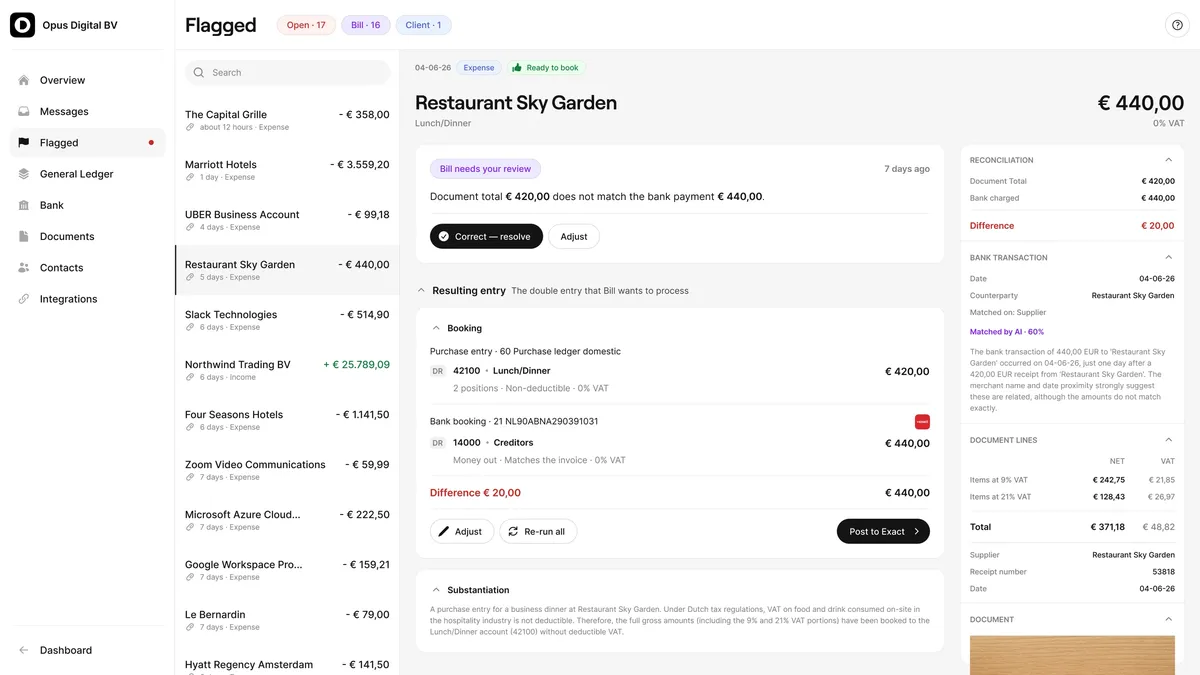
The biggest shift in the accounting sector since the spreadsheet. From annual accounts 18 months later to real-time mini-pivots based on daily actuals. How AI is Transforming Accounting.
From Bookkeeper to Business Advisor: How AI is Transforming Accounting
The biggest shift in the accounting sector since the spreadsheet
The Old Reality
For years, bookkeeping was a backward-looking activity. Coding transactions, performing reconciliations, compiling monthly reports. Essential work, but it only documented what had already happened. By the time business owners saw their numbers, the window to adjust course had often already closed.
Those days are over.
The AI Revolution in America
A fundamental shift is currently taking place in the United States in how accounting firms operate. A recent article by Loran Armstrong, COO at Rockwell Capital Group, aptly describes this transformation:
“Transactions started categorizing themselves with increasing accuracy. Reconciliations that used to take hours were completed in minutes. Our team now spends more time analyzing data instead of assembling it.”
The numbers support this: according to recent research, 84% of American accountants now use AI for document processing, workflow automation, and advisory support. Firms implementing AI automation report an average ROI of 340% in the first year.
From Numbers to Insight
The real story isn’t about technology—it’s about a fundamental role change. Where accountants used to say “Here are your numbers,” they now say “Here’s what your numbers are telling you, and here’s what you should do about it.”
This is the tipping point. Bookkeeping is evolving from a recording function into an interpretive one.
Armstrong cites a common example: a company shows strong revenue growth on paper but struggles with cash flow. Without deeper analysis, it’s easy to misdiagnose the problem. Cash flow challenges are often caused by payment terms, inventory management, or collection cycles—not a lack of sales.
Advisory-Led Firms Are Pulling Ahead
The gap between traditional and progressive firms is growing. Clients don’t need more spreadsheets. They want:
Clarity — no data overload, but actionable insights
Context — what do these numbers mean for my specific situation?
Guidance — how do I connect financial performance to operational strategy?
Firms making this transition—from compliance-driven to advisory-led—attract the most valuable clients and can justify higher fees.
The Human Factor Remains Crucial
There’s a growing narrative that accounting will become fully automated. That’s an oversimplification.
Technology is a powerful enabler, but it doesn’t replace judgment. In fact, as systems become more sophisticated, human interpretation becomes even more critical. Data doesn’t provide answers on its own—it raises questions. Understanding which questions to ask, and how to act on the answers, is where the difference is made.
The Accountant of the Future
The skill set required for success is changing rapidly:
Before: - Technical accuracy - Closing books - Creating reports - Looking backward
Now: - Interpreting trends - Leading conversations - Strategic advising - Real-time insight
What This Means for European Firms
The American market is often 2-3 years ahead of Europe. What we’re seeing there now—the shift toward AI-driven, advisory-focused services—is inevitably coming this way.
For European accounting firms, the question isn’t whether they need to transform, but how quickly.
Firms that invest now in: - Automation of repetitive work - Development of advisory capabilities - Training teams in data interpretation and client communication
…will be the winners of the next five years.
The Conclusion
Bookkeeping is no longer a function that sits at the end of the process. It’s being embedded throughout the entire business lifecycle, informing decisions in real-time and helping leaders navigate complexity with greater precision.
“In this new era, bookkeeping is about what’s happening now and what should happen next.”